Industrial Cleaning
Industrial Chemical Descaling
Service Overview
Engineered Chemical Descaling for Effective Scale Removal
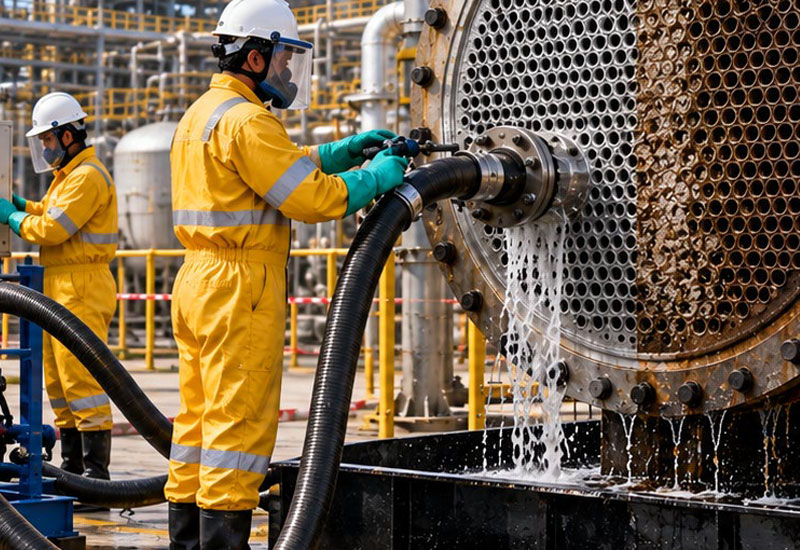
Excel Tech provides engineered chemical descaling services for the removal of scale, mineral deposits, corrosion products, rust, oxides and other inorganic buildup from industrial equipment, piping and process systems. Accumulated deposits can restrict flow, reduce heat-transfer efficiency, increase pressure drop and negatively affect equipment performance. Our descaling solutions are designed to restore internal cleanliness and help maintain the operational efficiency of critical process systems.
Each descaling program is developed based on the type, composition, thickness and distribution of the deposits, along with equipment configuration, metallurgy, operating conditions and the required cleaning outcome. Deposit characteristics may vary significantly between applications, therefore the cleaning chemistry and process conditions are selected specifically for the system being treated. Appropriate chemical formulations, concentration, temperature, circulation rate and contact time are established to achieve effective deposit removal while maintaining compatibility with the equipment and materials of construction.
Chemical descaling works by chemically dissolving or loosening accumulated mineral deposits and other inorganic contamination from internal surfaces. The selected solution is circulated through the equipment or targeted sections to provide consistent contact with affected areas. Controlled circulation helps improve chemical distribution and enables cleaning of complex internal passages, piping sections, channels, bends and other areas where conventional mechanical cleaning may be difficult or impractical.
Depending on the application and deposit condition, descaling can be performed on heat exchangers, boilers, condensers, pipelines, vessels, tanks, cooling-water systems, process equipment, valves and associated piping. Pre-cleaning or flushing may be carried out where required to remove loose contaminants before the chemical treatment begins. For heavily scaled systems, the process can be combined with flushing, hydrojetting or other suitable cleaning methods to improve overall cleaning effectiveness.
Our Services
Valve Manufacturing › Valve Maintenance & Supply › Valve Services › Critical Systems Cleaning › Refinery & Hydrocarbon Cleaning › Vapor-Phase Cleaning › Liquid-Phase Cleaning › Pipeline & Piping Cleaning › Chemical Cleaning › Chemical Descaling › Industrial Degreasing › Chemical Cleaning & Hydrojetting › Integrated Industrial Construction › Mechanical Construction › Civil Construction › Electrical & Instrumentation › Mining & Conveyor Systems › HDPE Pipe Welding & Geosynthetic Installation › Protective Rubber Lining › NDT & Calibration › Contact UsCLEANING OBJECTIVES
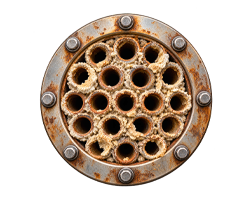
REMOVE SCALE & DEPOSITS
Remove calcium, limescale, rust and other mineral deposits from equipment surfaces.
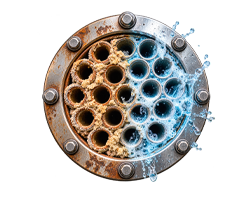
RESTORE FLOW & HEAT TRANSFER
Remove accumulated scale to improve internal flow paths and heat-transfer surfaces.
PROTECT EQUIPMENT
SURFACES
Apply selected descaling chemistry using controlled methods appropriate to the equipment and material condition.